The Architecture of Anguish: Why Fandom Can Tell When Trauma Writing Is Fake
The best stories do not use trauma as decoration. They use it as architecture. They build around the wound without turning the wound into the whole house.
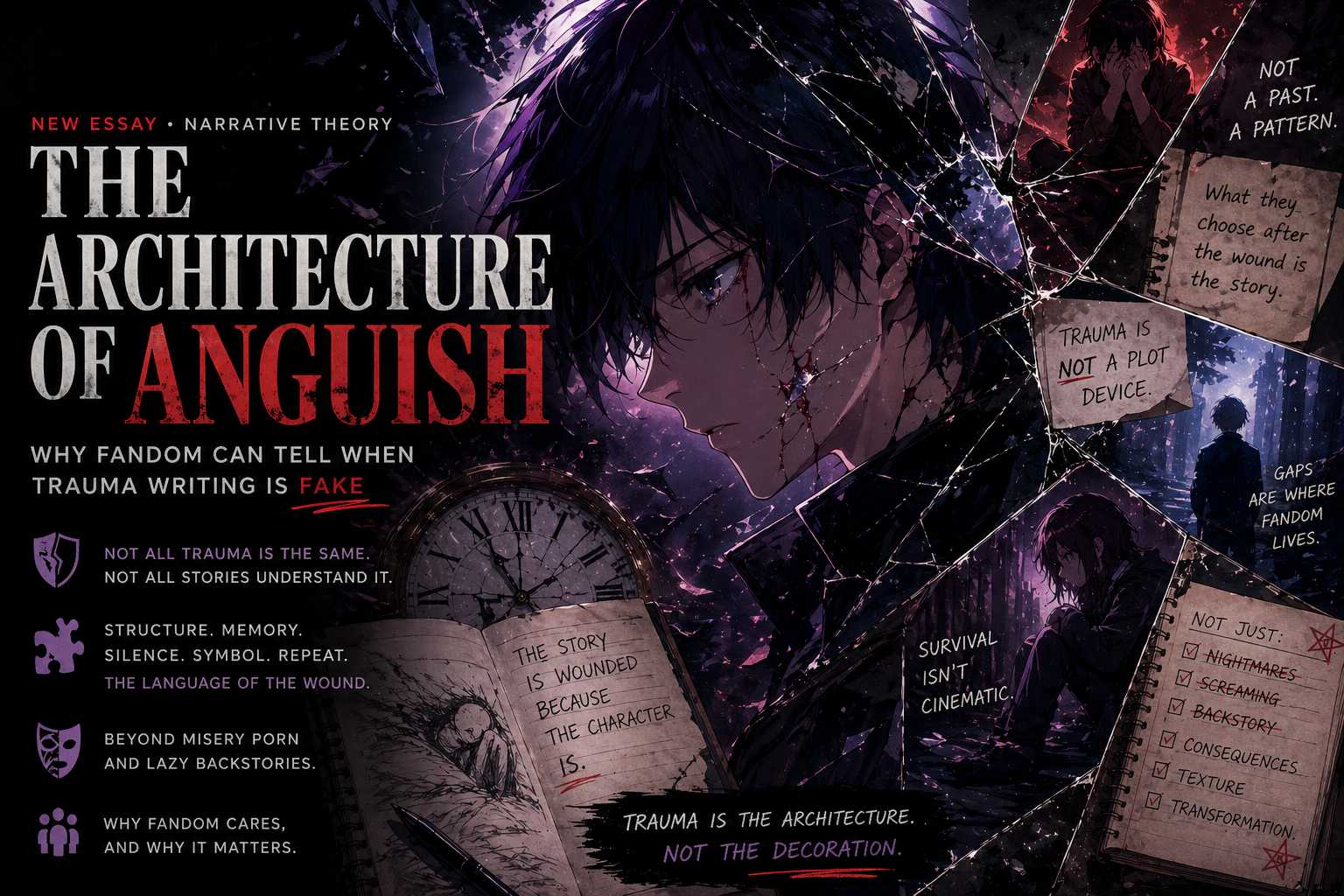
Fandom knows when a character’s trauma is doing real narrative work.
And fandom definitely knows when trauma has been slapped onto a character like emotional wallpaper.
You see it in comment sections, meta essays, Tumblr tags, AO3 author’s notes, Reddit arguments, video essays, and those gloriously unhinged “actually, this adaptation misunderstood the entire point” threads. Fans may joke. Fans may spiral. Fans may overanalyze a glance for 4,000 words.
But they are often asking one serious question:
Did this story understand the wound, or did it just aestheticize it?
That matters because trauma in fiction is not the same as trauma in real life. Real trauma is chaotic, bodily, expensive, isolating, and often brutally uncinematic. Fictional trauma is shaped. Structured. Symbolic. It is arranged into meaning.
And that is exactly where things get dangerous.
Trauma Is Not a Personality Type
Modern fandom has become very good at spotting “trauma as characterization.”
You know the type.
The brooding man with a tragic past. The emotionally shut-down woman whose pain explains every silence. The morally grey antihero whose violence gets filed under “he’s damaged.” The adaptation that turns every difficult choice into a trauma response.
It can be powerful.
It can also be lazy as hell.
Pain can shape a character, but it should not replace a character. A wounded person still has taste, humour, habits, desires, politics, petty grudges, terrible coping mechanisms, and weird little preferences. They are not just “a tragic backstory with legs.”
That phrase sounds rude because it is. But sometimes rude is accurate.
Why Fans Fight Over This Stuff
Fandom arguments about trauma writing are rarely just about plot.
They are about agency.
Was the character making a choice? Was the character reacting? Was the story excusing them? Was the adaptation softening them? Was the trauma being used to deepen the character — or to dodge moral complexity?
That is why characters like Joel from The Last of Us become such flashpoints. If a story frames a brutal act as a conscious, selfish, morally loaded decision, that creates one kind of character. If it reframes the same act as an involuntary trauma response, that creates another. The wound may remain, but the agency changes.
And fandom notices.
Because fandom is where character interpretation goes to court.
The Best Trauma Writing Breaks the Form
Good trauma writing usually does not just tell us a character is wounded.
It makes the story feel wounded.
Time fractures. Memories loop. Narrators become unreliable. Scenes repeat with new meaning. Silences become louder than dialogue.
This is why nonlinear storytelling, missing memories, symbolic imagery, and repetition show up so often in trauma narratives. The form starts behaving like the injury.
That is the good stuff.
That is when structure and psychology start holding hands in a dark hallway.
Why Fandom Loves the Gaps
Fandom lives in what canon leaves unsaid.
The missing scene. The unexplained reaction. The emotional aftermath canon skipped because there were only forty-two minutes and apparently we needed a car chase.
This is where fan fiction becomes more than “extra content.” It becomes emotional archaeology.
Fans go into the gaps and ask:
What did this cost them? What did they never say out loud? What does survival look like on an ordinary Tuesday? Who notices? Who stays?
That is often where fandom handles trauma better than canon. Not always, obviously. Sometimes fandom also rolls around in misery like a raccoon in a bin. But at its best, fan fiction refuses to let the wound be decorative.
It asks what the wound does.
Misery Porn Is Not Depth
A story is not automatically mature because everyone is suffering.
That is not depth. That is just the narrative equivalent of turning the lights off and calling it prestige.
Good trauma writing is not about maximum pain. It is about consequence, texture, and transformation.
The boring parts matter. The ugly parts matter. The recovery parts matter. The awkward, embarrassing, inconvenient parts matter.
Trauma is not only nightmares and dramatic breakdowns. It is fatigue. Avoidance. Medical fallout. Money problems. Bad sleep. Weird triggers. Silence. Shame. The body keeping score while the plot wants to move on.
Fandom often latches onto these details because they make characters feel lived-in rather than merely tragic.
Speculative Fiction Gets Away With Murder — Sometimes Brilliantly
Fantasy, sci-fi, and dystopian fiction can explore trauma with surprising force because they create distance.
Instead of saying, “Here is a real-world wound you already have defenses against,” speculative fiction builds a new system: cursed bloodlines, magical oppression, psychic bonds, altered bodies, broken worlds, inherited violence.
That distance lets audiences feel before they argue.
This is why a fictional oppressed class, supernatural stigma, or invented social hierarchy can sometimes hit harder than direct realism. The metaphor bypasses the usual mental security guards.
Very sneaky. Very effective. Literature wearing a fake moustache.
Final Theory
Fandom cares about trauma writing because fandom cares about character truth.
Not just what happened.
What it changed. What it failed to change. What the character chose anyway. What canon ignored. What the audience had to repair for itself.
The best stories do not use trauma as decoration. They use it as architecture.
They build around the wound without turning the wound into the whole house.
And maybe that is why fans keep returning to damaged characters, messy ships, post-canon recovery arcs, fix-it fics, missing scenes, and morally impossible choices.
Not because suffering is glamorous.
Because meaning is magnetic.
Because fandom knows that sometimes the real story begins after canon cuts to black.
Continue the signal
New essays on characters, fandom, and storytelling, with occasional notes from the observatory.
No notes yet — be the first observer.