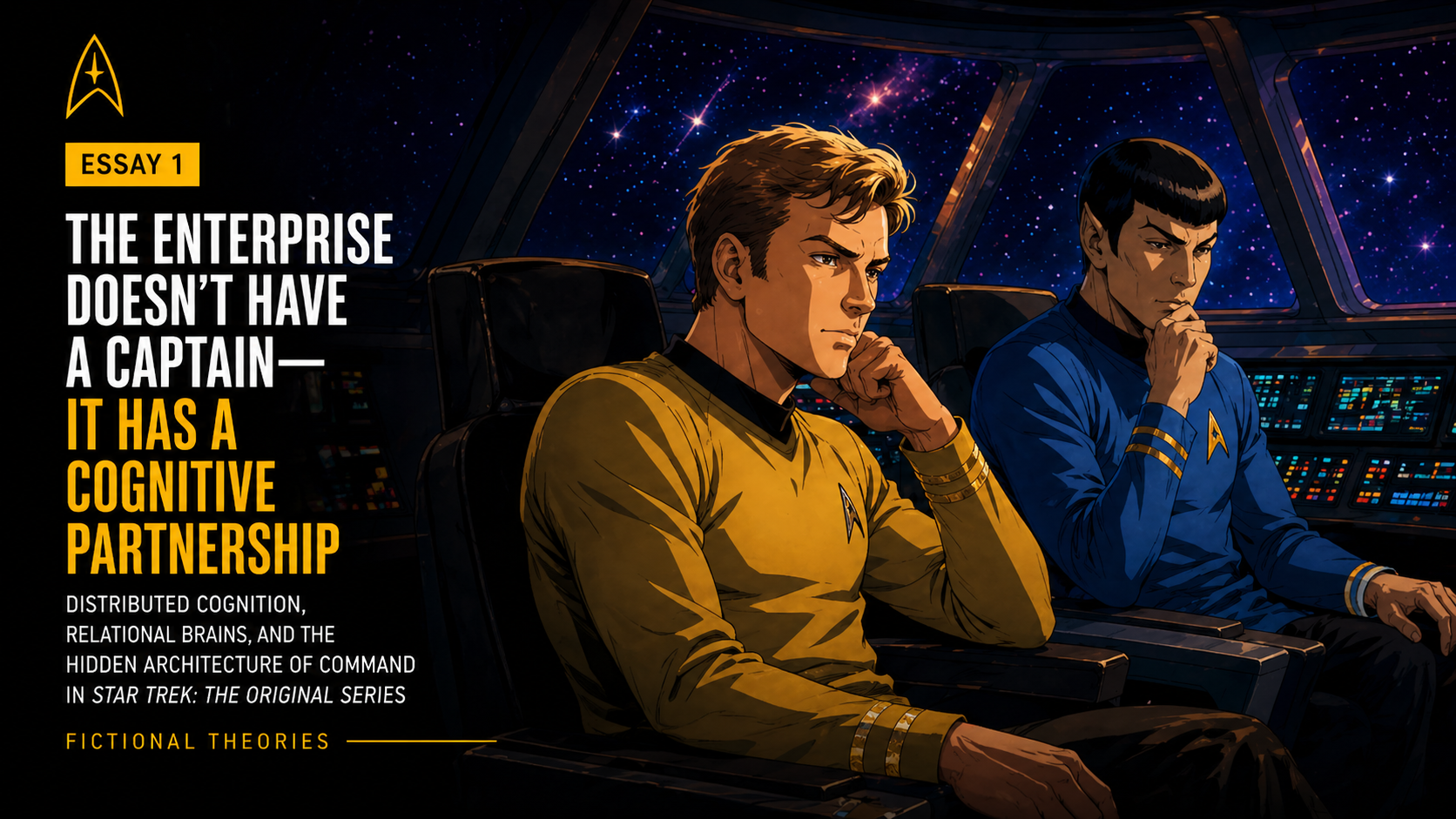
The Enterprise Doesn’t Have a Captain—It Has a Cognitive Partnership
Distributed Cognition, Relational Bias, and the Hidden Architecture of Command in Star Trek: The Original Series
1. The Performance of Command
Command, in Star Trek: The Original Series, is presented as both visual and narrative certainty. The captain occupies a fixed position at the center of the bridge, elevated slightly above the surrounding crew. Orders are issued from this position, reinforcing the image of authority as singular, decisive, and contained within one individual.
This presentation reflects a long-standing cultural model of leadership: the idea that effective command requires clarity, hierarchy, and the ability to act without hesitation. Kirk embodies this model at the level of appearance. He gives orders. He resolves crises. He carries responsibility.
Yet this image begins to fracture when we examine how decisions are actually made.
Kirk rarely arrives at conclusions independently. Instead, he engages in a consistent pattern of consultation—most often with Spock. These interactions are not formalities. They are moments of active negotiation, in which data, interpretation, and consequence are brought into tension.
Kirk asks questions that do not merely seek answers, but provoke reconsideration:
- What are the probabilities?
- What alternatives exist?
- What are the consequences of inaction?
These questions reveal something critical: command is not a singular act, but a process of convergence. The final decision may be voiced by the captain, but it is constructed through interaction.
“The captain does not decide.
He converges.”
2. Complementary Cognitive Architectures
The dynamic between Kirk and Spock is often reduced to a familiar binary: emotion versus logic, instinct versus reason. While this framing captures an aspect of their interaction, it oversimplifies the complexity of their cognitive relationship.
Spock’s reasoning is structured, systematic, and probabilistic. He reduces complex scenarios into analyzable components, seeking optimal outcomes based on available data. His approach prioritizes consistency, predictability, and efficiency.
Kirk’s reasoning operates differently. It is contextual rather than abstract, responsive rather than predictive. He evaluates situations not only in terms of probability, but in terms of meaning—what a decision represents, what it preserves, and what it risks.
Individually, each system contains inherent limitations.
Spock’s logic can produce outcomes that are technically optimal but ethically insufficient. His commitment to rationality may lead to hesitation when decisive action is required. Conversely, Kirk’s reliance on instinct can introduce volatility, leading to decisions that are effective in the moment but difficult to justify within a structured framework.
When these systems interact, however, their limitations are mitigated.
Spock defines the boundaries of what is logically possible. Kirk challenges those boundaries, testing them against lived experience and moral intuition. The resulting decision is not a compromise between two positions, but an emergent synthesis—a solution that arises specifically from the tension between them.
3. Distributed Cognition and the Enterprise
The concept of distributed cognition provides a useful framework for understanding this interaction. Rather than locating thought within a single mind, distributed cognition posits that cognitive processes can be spread across individuals, tools, and environments.
The Enterprise operates in precisely this manner.
Spock functions as an analytical processor, translating complex situations into structured data. Dr. McCoy introduces an additional layer, articulating emotional and ethical concerns that resist reduction. Kirk integrates these inputs, transforming them into actionable decisions.
This structure is not linear. It is iterative.
Ideas are proposed, challenged, revised, and reinterpreted. Agreement is not the goal. Instead, the system relies on sustained tension between differing perspectives. This tension prevents premature closure, ensuring that decisions are tested from multiple angles before being enacted.
In this sense, the Enterprise does not simply contain a crew. It contains a cognitive system, one in which thought emerges through interaction rather than isolation.
“The Enterprise does not run on authority.
It runs on interaction.”
4. Relational Bias and the Limits of Logic
Despite Spock’s commitment to rationality, his behavior reveals a consistent deviation when Kirk is personally involved. In situations where the captain’s safety is at risk, Spock demonstrates an increased willingness to override protocol, reinterpret data, and accept outcomes that would otherwise be considered improbable.
This shift can be understood as a form of relational bias—an adjustment in decision-making priorities based on personal attachment. From a strictly logical perspective, such bias represents a flaw, introducing subjectivity into an otherwise objective system.
However, within the context of the Enterprise, this bias performs a critical function.
Kirk’s leadership depends not only on Spock’s analytical capabilities, but on his capacity for adaptive reasoning. The willingness to deviate from strict logic allows the system to respond to scenarios that exceed purely rational calculation. In effect, relational bias introduces flexibility, enabling decisions that account for both data and relationship.
This does not negate Spock’s logic. Rather, it reveals its limits—and its capacity to evolve under pressure.
5. Emergent Intelligence and System Evolution
Over time, the repeated interaction between Kirk and Spock produces measurable changes in their decision-making process. Exchanges become more efficient. Explanations shorten. Each begins to anticipate the reasoning of the other.
This development reflects the emergence of a shared cognitive framework.
Spock becomes increasingly capable of accounting for contextual and emotional variables, while Kirk demonstrates a growing appreciation for structured reasoning. These shifts do not eliminate their differences, but refine them, allowing for more precise integration.
The result is a form of intelligence that cannot be attributed to either individual alone. It is a property of the system itself—a product of sustained interaction, adaptation, and mutual influence.
Key Takeaways
- The Enterprise operates as a distributed cognitive system
- Kirk and Spock form a complementary decision-making loop
- Logic and intuition function as interdependent inputs
- Relational bias introduces adaptive flexibility
- Their partnership produces emergent intelligence
Conclusion
The image of the captain as a singular decision-maker remains one of the most enduring tropes in science fiction. Star Trek: The Original Series appears to uphold this image, presenting Kirk as the central figure of command.
Yet beneath this surface lies a more complex reality.
The Enterprise does not operate through the isolated cognition of one individual. It functions through a distributed system, in which logic, intuition, and relational bias interact to produce adaptive, context-sensitive decisions.
At the center of this system lies the partnership between Kirk and Spock—a relationship that transforms difference into function, and tension into clarity.
In this sense, the true engine of the Enterprise is not technological, but relational. It is found not in the captain’s chair, but in the space between two minds—each incomplete on its own, but together capable of navigating the unknown.
Continue the signal
Quiet letters from the observatory. New theories, occasional notes — never spam.
Sign in to leave a note.
No notes yet — be the first observer.