Three Men, One Mind
Kirk, Spock, and McCoy as a Cognitive Trinity
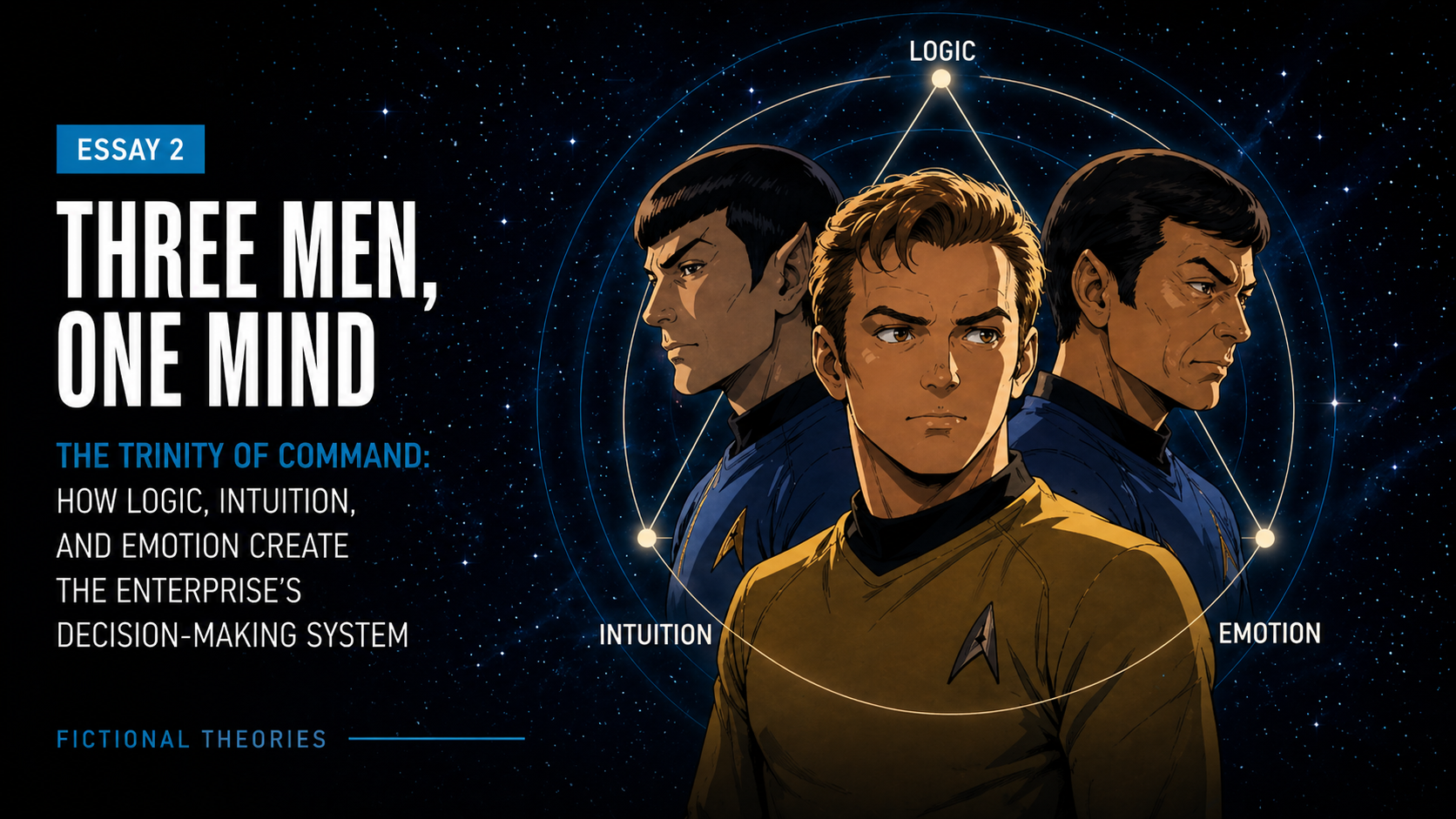
1. Beyond the Binary
The Kirk–Spock dynamic is often framed as a binary: logic versus emotion, reason versus instinct.
It is a compelling simplification.
It is also incomplete.
Because the system does not operate in pairs. It operates in tension, and that tension has a third force.
McCoy.
Dr. Leonard McCoy is sometimes treated as the emotional counterweight to Spock, or worse, as a source of comic irritation. But this reading underestimates his structural function. McCoy is not merely there to argue. He is there to disrupt premature certainty.
Where Spock abstracts, McCoy particularizes. Where Spock calculates, McCoy insists on consequence. Where Kirk may be tempted to act quickly, McCoy forces the ethical weight of action back into the room.
The Enterprise does not think in binaries.
It thinks in tension.
“The Enterprise does not think in binaries.
It thinks in tension.”
2. The Missing Component
Spock abstracts. Kirk acts. McCoy resists.
That resistance matters.
McCoy’s role is not simply emotional expression. He functions as ethical friction inside the decision-making system. He challenges the reduction of human life into variables, the smoothing of moral complexity into acceptable losses, and the illusion that an efficient answer is automatically a correct one.
In many stories, the emotional character exists to humanize the logical one. McCoy does more than that. He humanizes the entire structure of command.
He asks the questions that logic can avoid:
- Who pays the cost?
- What kind of people do we become if we accept this?
- Is survival enough if dignity is abandoned?
These questions are not sentimental distractions. They are necessary constraints.
Without McCoy, the Kirk–Spock system risks becoming too efficient, too enclosed, too convinced of its own coherence. McCoy breaks that coherence open. He keeps the system ethically unstable enough to remain human.
3. The Structure of the Trinity
The triadic system can be understood through three distinct cognitive roles:
- Spock → Analytical Reason
- McCoy → Ethical Conscience
- Kirk → Integrative Will
Each role performs a different kind of thinking.
Spock defines the logical structure of the problem. He identifies probabilities, constraints, risks, and outcomes. His function is to clarify what is possible.
McCoy defines the human stakes. He brings pain, fear, dignity, loyalty, and moral consequence into the frame. His function is to clarify what is acceptable.
Kirk integrates these pressures into action. He does not simply split the difference between Spock and McCoy. He absorbs the friction between them and converts it into a decision.
That conversion is the heart of command.
This is why the system depends on disagreement. If Spock and McCoy always agreed, Kirk’s decision-making would become weaker, not stronger. The value lies in the pressure between them.
The system does not seek agreement.
It seeks pressure.
“The system does not seek agreement.
It seeks pressure.”
4. Productive Conflict
The friction between Spock and McCoy is one of the defining pleasures of Star Trek: The Original Series. Their exchanges are sharp, comic, and often personal. But beneath the surface banter is a serious structural function.
Their conflict prevents the system from collapsing into a single mode of thought.
Spock pushes toward abstraction. McCoy pulls toward embodiment. Spock asks what is logical. McCoy asks what is humane. Spock calculates survival. McCoy asks whether survival has preserved the values that made it worth pursuing.
This conflict is not dysfunction.
It is processing.
Kirk’s role is not to silence it. His role is to use it. He allows their disagreement to sharpen the stakes before he acts. In doing so, he turns conflict into cognition.
The Enterprise survives not because its leaders agree, but because they argue productively enough to reveal the shape of the problem.
5. Collapse Conditions
The strength of the triadic system becomes most visible when we imagine one element removed.
Without Spock, the system loses structure. Decisions become reactive, improvisational, and vulnerable to emotional overreach.
Without McCoy, the system loses ethical grounding. Decisions may become efficient but morally thin, optimized for outcome rather than meaning.
Without Kirk, the system fails to resolve. Logic and conscience may continue to argue, but without integration, the debate cannot become action.
Each component is necessary.
None is sufficient.
This is what makes the trio more than a collection of personalities. Together, they form a thinking structure. The intelligence is not located in Spock’s logic, McCoy’s conscience, or Kirk’s authority alone. It emerges from their interdependence.
Remove one voice, and the system collapses.
The intelligence was never individual.
It was the tension between them.
Key Takeaways
- The Enterprise operates as a triadic cognitive system
- McCoy functions as ethical resistance, not comic relief
- Productive conflict is the engine of decision-making
- Kirk integrates tension into action
- The system relies on interdependence, not agreement
Conclusion
The Enterprise is not commanded by a single individual, nor even by a simple partnership. At its most effective, it operates through a cognitive trinity: a system in which logic, conscience, and action are held in productive tension.
Spock gives the system structure. McCoy gives it moral weight. Kirk gives it direction.
Together, they transform disagreement into decision.
This is why the trio endures. Not because they represent tidy archetypes, but because they model a form of thinking that feels recognizably human. We do not make decisions through logic alone, nor through feeling alone, nor through action alone. We move between them, pressured by each, refined by their conflict.
The Enterprise does not think in binaries.
It thinks in tension.
Continue the signal
Quiet letters from the observatory. New theories, occasional notes — never spam.
Sign in to leave a note.
No notes yet — be the first observer.